
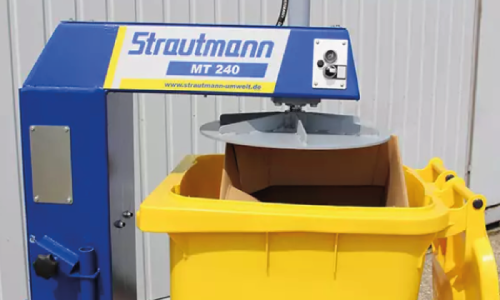
Congratulations on being the proud owner of a wheelie bin! It might even be that your business is so inundated with waste that you have three or perhaps four wheelie bins, and yet you still find them overflowing at the end of the week. So, what’s the solution? Buy more wheelie bins? Buy ten wheelie bins? Buy a wheelie bin for every single piece of waste you produce, and stack them on top of each other in a plastic bin-shaped effigy to the very concept of waste management, then carve out 10 minutes of every day to gather staff at its base and pray the company produces less waste?
Don’t be absurd! You probably just need a wheelie bin compactor press. Not only will this save you space in your bins, if you opt for an electric compactor press, you can mitigate any manual labour involved in pushing waste down into a bin. This results in less labour-related staff injuries, and saves time for primary operations.
There are a variety of options for compactor presses, and one of the questions that comes up a lot is whether a company should invest in either a manual compactor or a plate compactor. Is there much difference between these two types of compactor?

A manual compactor is (you guessed it) operated by hand and will press waste into a wheelie bin up to the maximum amount of strength the operator can apply to it. If you’re disposing of a lot of bulky waste like sheets of cardboard, with each sheet that is put into the bin, the manual effort required to make more space increases, as does the potential for injuries. Manual bin compactors are excellent tools for reducing waste volume in a typical setting where waste is made up of small items that are easily pushed down, and in fact this may be ideal if you simply need to reduce your waste volume by a relatively small amount.
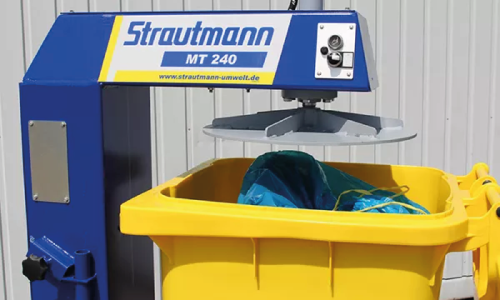
A plate compactor, however, does away with manual handling altogether and dramatically reduces the volume of waste in any wheelie bin, sometimes by up to 85%. Mitigating injuries, the hands-free aspect also eliminates the potential of touching old waste and causing contamination or spreading disease. As an example, Strautmann’s in bin compactor offers safe two-hand operation through the use of easy-access buttons that push a plate into a wheelie bin to squash waste down. All this is done without damaging the bin itself, lifting it up to prevent the wheels from being crushed. In industries like hotels, hospitality, and social and public institutions, the MT240 thrives, able to fit with 240 litre bins inside or outside. The process is fast and efficient, which gives it an edge on manual compactor presses which can take more time to produce less than equivalent results.